Thursday, 15 April 2010

The distribution of my first pack...

Whilst at college today, I gave out my first pack (the one mentioned in my previous posting). I asked the participant if they wanted to participate first of all, from which the answer was yes! :-)

I wonder if I would get a different response if the packs I have put together were left in a particular location/place and then people could choose if they wanted to participate or not (like with my disposable cameras), rather than being forced to feel as if they should participate as a result of direct communication?  

I provided the participant with the pack of the materials whilst explaining that there was no obligation whatsoever to use any of the materials that I had provided. They could use as many of they wished to, in addition to any others of their choosing. I asked the participant to respond to the word 'art' and encouraged them to interpret this in which ever way they wished.

I wonder if the participants interpretation of the word 'art' will have an impact on what they have been asked to do and what they create? For example, if I hadn't directly mentioned anything about interpretation, would this have had an impact on what the participant actually creates rather than what they would have created if they knew this piece of information? These are some thoughts to ponder so I will wait and see what results I get....   :)

Experiences of participatory art within the public domain...

Whilst talking about my art project with a college tutor, we came across the subject of 'The Seal Soap Installation' (artist unknown) that she had seen and participated with at the San Francisco Museum of Modern Art. Following my conversation with my tutor, I have attempted to find some reference material to this installation on the internet and on the San Francisco Museum of Modern Art's website archive, but this only goes back to 2000. Nevertheless, here is a recount of her experience:

"Basically there was a very large white room that had mirrors on two sides with small white soap seals spread out all over the floor. My interpretation was to interact with the art/installation by paying $1 to move a seal. The implication of this was to take the soap seal home, which is what most people seemed to do. The money collected for the purchase/interaction with the soap seals was going to be donated towards AIDS research. It is probably significant to note that this installation, I think, was up in the late 80s/early 90s. In this installation and the context of participatory art, I thought that the message was to consider moving the seal in relation to your comfort zone with AIDS. Whether this is how closely you have been affected by AIDS, how close you would be comfortable being next to someone with AIDS, how you understand AIDS, and then move the seal to reflect this. I think the point of the seals being white was to consider themes of cleanliness and they were symbolic of harp seals who were endangered and inaccessible. AIDS of course results in decreased white blood cell counts. Nothing was written within the installation, so of course any movement of the seals was interpretative, and as I said, my experience was that most people took seals home once they paid money. Very few people actually walked amongst or near the seals unless they were 'purchasing one' when I was there."

(Lorraine, Loveland-Armour: 14th April 2010).

I have found it particularly interesting to note here that the visitors who physically participated with the installation were required to pay in order to have the opportunity to do so. Nonetheless, the money collected for participation with the soap seals and indeed the art was going towards a good and beneficial cause. From speaking to my tutor, she was also able to tell me that a fair amount of people were participating with the installation. Again, could this have been as a result of the artists intention and its relevance within a cultural context at that specific point in time? E.g. raising a greater awareness of AIDS during the late 80s/early 90s when this was a time that AIDS was beginning to become much more recognised as a prominent issue amongst our populations and global society?

From all of the participatory art that I have found and researched thus far, it appears that the great majority if not all of it has been based within an installational context. So I can identify this as a common characteristic of this art type. If my end outcome for this years art project will result in an installation, this will be a really exciting concept for me to pursue.

When I started this year, I would have never even considered that I would pursue an avenue within my art that challenges and completely changes my views on aesthetics and perceptions of final outcomes and how they should hold themselves within an exhibition. But this goes to show that exploring aesthetics as a concept through the critical issues module, and finding one inspiring artwork/concept has the scope and potential to change and influence the way that I think about and create art.

Who knows, my end of year outcome may well be an installation! But one thing I do know is that my processes, and spending the time developing and refining these processes will shape, mould, and define the way in which I choose to exhibit my work.   

Wednesday, 14 April 2010

The next step in my journey...

Following my last experiments with the disposable cameras, I have thought about how I could get people to engage in participatory art in another way, and encourage them to respond to a task/question/theme.

So with this in mind, I have put together some packs which consist of some stationary items which we often use on a daily basis. The packs consist of: various sized post it notes, an elastic band, a piece of string, a couple of paper clips, a treasury tag, a wax crayon, and an index card.


My intention is to allow those who participate within this experiment to use any of these materials, in addition to any others of their choosing to respond to a question/word/theme/issue.

But the problem is, I don't know what the question/word/theme/issue could be. There are so many things it could be. For example, art. Many people hold an opinion/perception in relation to art. I could ask the participants to respond to the word 'art', but then I am concerned that this would perhaps disengage participants who percieve themselves as 'not good at art'. Also, I have been thinking about the connotations that suggesting a theme/issue/question/word may have upon the process. Could this potentially restrict participants in the sense of the freedom of expression, or would it provide a suggested framework which could be interpreted by the individual? But at the same time if I don't give the experiment a context, I think that it will prove to be more difficult to evoke a response/reaction from potential participants. E.g. 'what should I do with the pack? I haven't got any ideas!' etc. So by actually thinking about this, I think it's conclusive that the experiment should have a theme/context attached to it. 

On the flip side, this process is about trying and experimenting with different ideas and seeing what happens as a result. The result from such an experiment can then contribute to informing the next steps of my journey and development. 

As McNiff (1998, p.41) discusses,

"The discipline of art requires constant experimentation, wherin errors are harbingers of original ideas because they introduce new directions for expression. The mistake is outside the intended course of action, and it may present something we never saw before, something unexpected or contradictory, an accident that can be put to use."

On a school level, I actively seek to implement this principle into my pedagogy in encourgaing children to become increasingly aware of the nature and process of art in relation to their individual needs, progress and development over sustained periods of time.  

As I am writing this blog entry, I have updated my status on Facebook as: "Jaz Hayer would like to know who would like to get involved in his art project? It's nothing 'dodgy', I promise! I would really appreciate it! Thank you! :)"

Some of the responses that I have had from this status include: "I can't draw or paint!", "Matchstick men are about my limit" and "Jaz, I can't draw either". These comments go back to what I was saying before about the varying perceptions of our own expectations, abilities and capabilities towards art. Are these informed by our own experiences and perceptions of what art is and what it means to us? I believe that we can all draw and paint, and create visual representations to act as a tool  our self expression. But is art just about drawing and painting? NO NO NO!!! But this is how it is commonly percieved.

It's also interesting to note that potential participants of my experiment have also automatically presumed that it will require them to draw/paint. Has a historical and cultural context imposed this view of art upon society throughout time and across generations?   

So maybe through my experiment and the pack that I am intending to provide, I could encourage and explore participants to consider their perceptions towards art as a theme/issue in itself?

I have also learnt that Hannah has a participatory art background. So I will arrange an appointment for a tutorial, and hopefully gain more of an insight into some of the artists involved in this style of art, possible references to wider research/reading based on participatory art, and share & discuss my ideas and progress to date!  :-)    

References:

McNiff, S. (1998) Trust The Process - An Artist's Guide to Letting Go. Massachusetts: Shambala Publications Inc.
Anthony Gormley: 'One and Other'

When the three arty farty's were in London back in September, we went to The National Gallery and National Portrait Gallery situated by Trafalgar Square. On our way to the square, we came across Anthony Gormley's active installation 'One and Other'.

Gormley's installation ran for a total of 100 days, 24 hours a day, with the plinth being occupied by a different person at each hour of the day. Participants were chosen at random from the near 35,000 people that had applied to be involved.

Reflecting back on viewing and experiencing this installation, we can consider this is as participatory art, as the general public were provided with opportunities to do as they wished on a plinth that would usually be reserved for statues of royalty and generals of our nation. Gormley provided opportunities for us, the general public to have access to a location that would not normally be within the realm of possibility for us. "Gormley asked the people of the UK to occupy the plinth  in an image of themselves, and a representation of the whole of humanity."
 http://www.london.gov.uk/fourthplinth/plinth/past.jsp 


The participants had changed twice by the time that we had been to The National Gallery & National Portrait Gallery!

As the website for the One and Other project states, "People from every walk of life, and every corner of the UK have become part of history and together created a collective portrait of humanity that is richer than anyone could have imagined."
http://www.webarchive.org.uk/wayback/archive/20100223121754/http://www.oneandother.co.uk/about

As Alex Needham commented for The Guardian, "'What artwork has ever given 2,400 ordinary people the chance to become art itself?"

Prior to Anthony Gormley's installation, the plinth has also been used by artists including Thomas Schütte and Marc Quinn  to publically exhibit their work. Having done some more research into the plinth, The fourth plinth programme is part of the vision for Trafalgar Square to be a vibrant public space and to encourage debate about the place and value of public art. This concept is really exciting, and it will be interesting to see what future developments will take place on the plinth and how the public respond to this. Will the developments/initiatives have as much success as Gormley's installation? Will the general public be provided with ownership of the space within another context/dimension? Or will the space be used to exhibit artworks that challenge and push the boundaries with art?   

Anthony Gormley explained in October 2009,

"Who can be represented in art? How can we make it? How can we experience it? These are questions that have exercised me for years. Whether you see the plinth as a protest or pole-dance platform; studio or stocks; playpen or pulpit; as a frame for interrogation or for meditation, it has provided an open space of possibility for many to test their sense of self and how they might communicate this to a wider world."

So thinking about the concept of the fourth plinth and Anthony Gormley's intention critically, he has actually juxtapositioned the purpose and intention of the plinth, and made it somewhat ambigous within a cultural context. The plinth pushes boundaries as a result of the placement of single human beings on there, when this is compared and contrasted to the huge statues that dominate and reside on the other plinths. As Alex Needham in his newspaper article on the project explains, "There was also something very poignant about the sight of a single human on a space designed for a massive statue. Gormley championed the little guy against the intimidating grandeur of the square's institutions – not least the National Gallery, whose director condemned the project."

Daniel Buren

I have Amy to thank for this link to another artist that engages the viewer in active participation. Thanks Amy! :)

Daniel Buren has created an installation piece called 'Intervention II'. The exhibition comprises of a painted wall, with sliders that contain different coloured squares of perspex, as well as pieces of perspex which have been hung from the ceiling. The viewer of the wall installation can take an active participatory role within the experience of the art by moving the sliding components of the wall installation as they wish to, and create different colour combinations. So ultimately, the viewer can construct their own perceptions/views in response to Buren's art and the conditions and resources that he has provided in which to do so.

As Amy states on her blog, the sliders "allow the viewer to change their original perceptions and ideas about the art work." The intention of Buren's work relates to the positioning of the perspex structures within the gallery space in relation to windows, and the coloured perspex's interaction and reaction with light.

So  from a  participatory art perspective, would the viewer of Buren's work be able to engage with the art objects intention and purpose meaningfully without being able to manipulate how they percieve it to be and represent this within their response? Without the sliding/participation element to his work, wouldn't Buren be restricting the viewers of the work in responding to what he is expressing and exploring within his work?

I think that allowing the viewer to manipulate/co-construct how they percieve the artwork is important in being able to access and interpret its intention, and purpose. After all, we all percieve art in different ways, and as well as being objective, it can be subjective in relation to our individual knowledge, understanding, and experiences. 


Tuesday, 13 April 2010

The Art of Participation 1950 - Now

Whilst doing some internet research, I have come across an example of participatory art that I would like to share with you.

The piece is a part of an exhibition called 'The Art of Participation 1950 - Now' and is located at the San Francisco Museum of Modern Art. The exhibition presents an overview of participatory art practice during the past six decades, exploring strategies and situations in which the public has taken a collaborative role in the art making process.

In particular, I came across this piece which I think is absolutely brilliant:


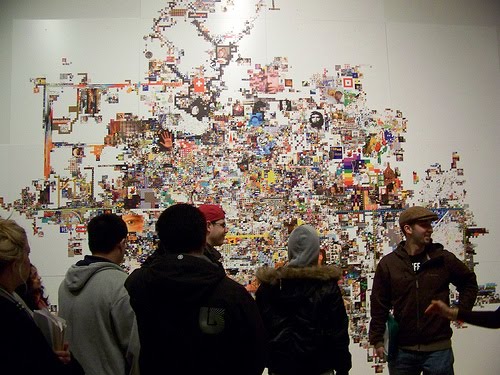
The piece is called 'Communimage - a moment in time VI' The piece has been developed by a range of multimedia artists and designers from across Europe, and in particular, Austria. 

Due to advances in technology, in particular the internet, new opportunities for communication and networking have been created. So with this in mind, the artists/designers wanted the internet to act as a tool in taking and applying a new meaning in 'shared authorship and collective production (communimage).

The artists/designers invited and encouraged the internet community to upload pictures onto a website. Contributions by those who participated range in varied subject matter. They include photorealistic images, animated images, to the intimate and the exhibitionist images!

When these images were put together, they created a large scale collective map, which represented the global internet community in relation to those who participated within the project. Almost 26.000 images were uploaded and used within the piece. 

The Austrian Cultural Forum on their website state that, "Viewed as a whole (one encounters it in the gallery as a large-scale print), communimage forms an abstract, polymorphous shape." So does this piece of participatory art reflect on the status of the image in the public realm and domain?

This has given me something else to think about within my practice & which follows on from yesterday's visit to The Public...intention and purpose of my art in relation to public realms/domains.

Monday, 12 April 2010

The Public - West Bromwich

Today me and Rachel ventured to The Public in West Bromwich. Despite some of the negative views that I had heard about it, I found the museum/gallery to be really inspiring and engaging.


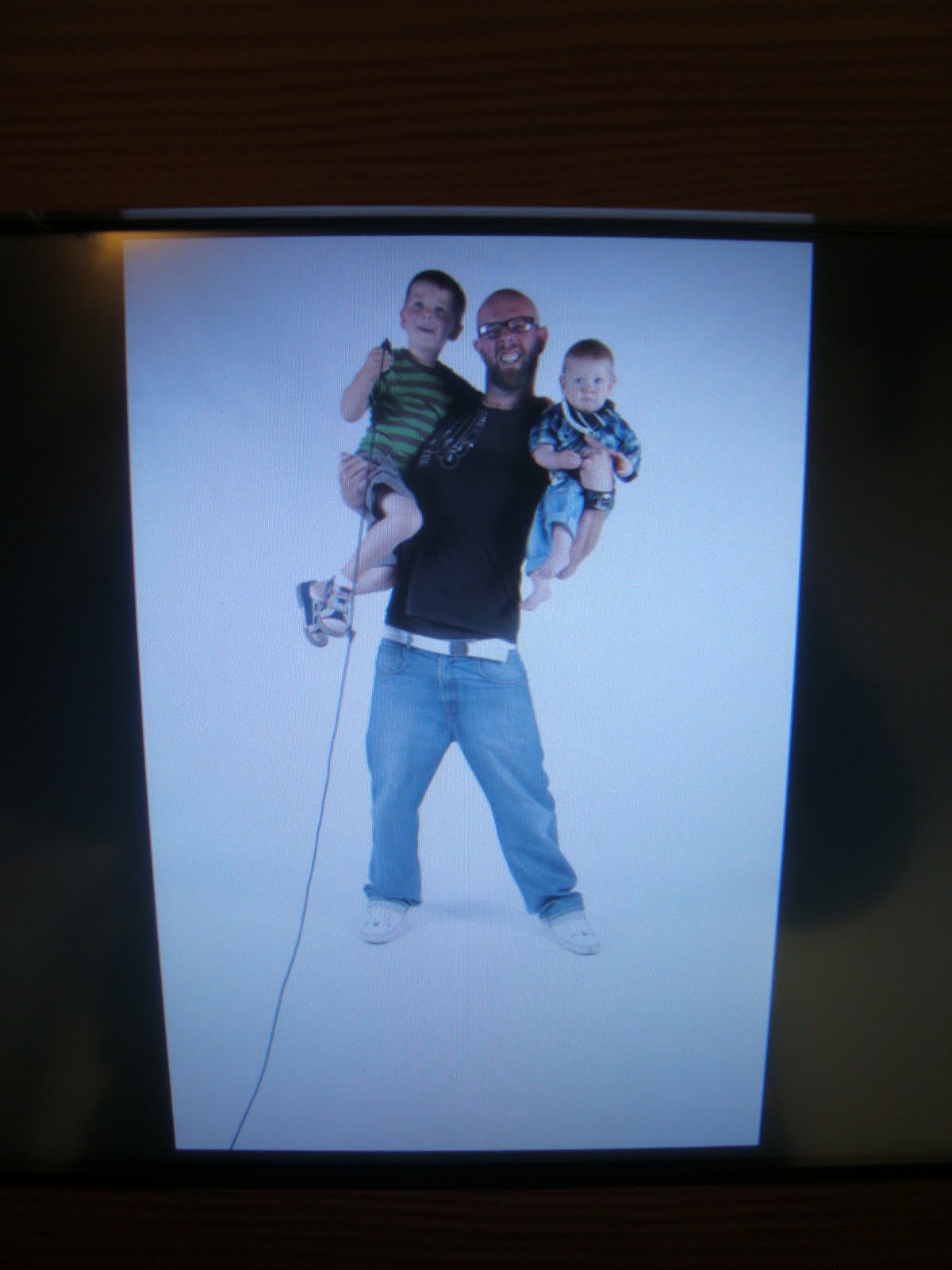
During our visit, I came across 'The Public Self Portrait Project'. Having explored the exhibition, I established that it relates to the theme of participatory art. The project began in June 2009 and to date has had over 5000 people participate. 

The project allows members of the general public to participate within the creation of their self portraits via a cable release from the digital photography equipment. This mechanism allows individuals to take control of how and when they want their photographs to be taken, therefore encourgaing the co-creation of the work.

Here are some of the pictures from the exhibition:


I really like these photographs. They capture a moment in time as well as recognising, celebrating, and promoting our diversity.

A great project, with an intention that allows the photographs to form an archive, which become more valuable over time as a record of who we are. I think that the intention of the project has contributed to its ongoing success, which has therefore encouraged the general public to actively participate. 

From this exhibition, I have come to recognise that the intention and purpose of participatory art needs to be clear. So this is something that I need to think about, consider, and develop in relation to my own practice and its success.